
Google Ads for Doctors: The Complete SEO Outline for Medical Practices
If you run a medical practice, chances are you’ve heard two pieces of conflicting advice: “you need SEO” and “you need Google Ads.” Both are true, but almost nobody explains how they actually fit together — or in what order to tackle them. This article lays out a practical google ads for doctors seo outline you can follow whether you’re managing marketing in-house or trying to figure out what to ask a marketing partner.
We’ll cover doctor seo from the ground up, why local search matters more for practices than almost any other business type, what changes when you’re a surgeon or specialist instead of a general practitioner, how paid campaigns should be structured, and how to evaluate outside help if you decide to bring in a team.
Why Doctors Need Both SEO and Google Ads
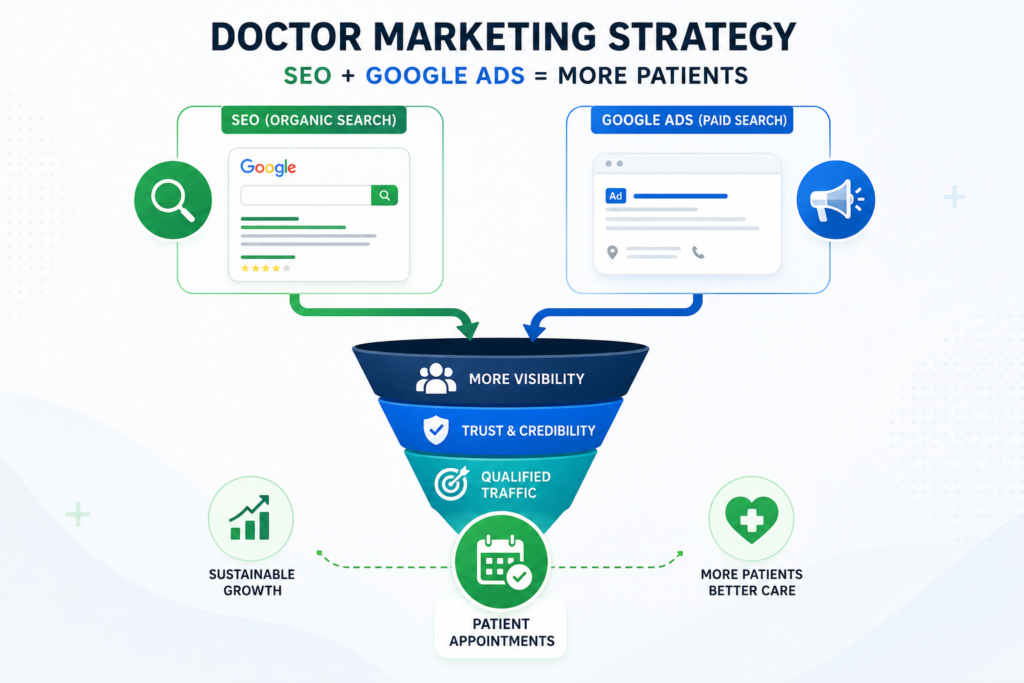
Here’s the short version: SEO and paid search solve two different problems, and a practice that only invests in one is leaving patients on the table.
SEO is the long game. It’s how your practice shows up organically when someone searches “pediatrician near me” or “knee surgeon in [city]” without clicking on an ad. It takes months to build, but once it’s working, it keeps working with relatively low ongoing cost — you’re not paying per click for that visibility.
Google Ads is the fast lane. It puts your practice at the top of the page immediately, for the exact terms you choose, the moment a campaign goes live. It costs money every time someone clicks, but it doesn’t require months of patience to start generating calls and bookings.
Most successful practices run both at once: paid ads generate patients while the organic SEO work builds up in the background, and once that organic foundation is strong, the practice can often reduce ad spend without losing visibility. That’s the core idea behind a combined outline instead of picking one channel and ignoring the other.
This matters more in healthcare than in most industries, simply because of how much trust is involved. A patient choosing a provider is making a decision that affects their health, not just picking a product off a shelf, so they tend to research more thoroughly before booking. That extended research window means your practice needs to show up consistently across multiple searches over days or weeks, not just once. Relying on a single channel makes that far less likely.
Local SEO for Doctors: The Foundation of Patient Search
Almost every patient search starts with location. Someone doesn’t just search “cardiologist” — they search “cardiologist near me” or “cardiologist in [neighborhood].” That makes local seo for doctors the single most important layer of the whole strategy, more foundational than general website SEO.
A few things matter most here:
-
- A complete, verified Google Business Profile. This is the listing that shows up in the map pack, with your hours, phone number, and reviews front and center. An incomplete or unverified profile is one of the most common reasons a practice doesn’t show up locally at all.
-
- Consistent name, address, and phone number (NAP) everywhere online. If your practice is listed slightly differently on your website, your Google profile, and directory sites like Healthgrades or Yelp, that inconsistency can quietly hurt your local rankings.
-
- Genuine patient reviews. Review volume and recency are ranking factors, not just trust signals. A steady stream of real reviews (never incentivized or fabricated) helps both rankings and conversion once patients land on your listing.
-
- Location-specific website content. If you have multiple offices, each one deserves its own page with unique details, not a single generic “locations” list.
Google Business Profile Optimization
Beyond the basics, a well-optimized profile includes accurate service categories, updated photos of the office and staff, and prompt responses to patient reviews (both positive and negative). Google increasingly rewards profiles that show ongoing activity, so treating this listing as a “set it and forget it” task is one of the most common mistakes practices make.
SEO for Surgeons and Specialists
General doctor SEO and seo for surgeons aren’t the same strategy, even though they share a foundation. Patients searching for a surgeon are usually much further along in their decision-making process — they often already have a diagnosis and are comparing specific providers or procedures, not browsing generally.
That changes what the content needs to do. A general practice might rank well with broad service pages, but a surgical practice typically needs:
-
- Procedure-specific landing pages, each built around one surgery or treatment rather than a single “our services” page trying to cover everything
-
- Content that addresses pre- and post-procedure questions, since these searches carry high intent and low competition compared to broader terms
-
- Credential and outcome-focused content, since trust matters enormously when someone is choosing who will perform a procedure on them
-
- Location-specific procedure pages, combining the local SEO principles above with the specificity a surgical search requires
This is also where keyword research needs to go deeper than general practice SEO. Someone searching “minimally invasive knee replacement recovery time” is a very different, and often more valuable, visitor than someone searching “orthopedic doctor.”
Google Ads for Doctors: Structuring Paid Campaigns
Once the organic foundation is in place, google ads for doctors campaigns should reinforce it rather than compete with it. A few structural decisions matter more than most people realize.
Structure campaigns by specialty or procedure, not by practice as a whole. A single broad campaign for “cardiology services” performs worse than separate, tightly focused campaigns for specific conditions or procedures, because the ad copy and landing page can match the search far more precisely.
Send traffic to a matching landing page, not the homepage. If someone clicks an ad for “same-day dental emergency,” they should land on a page about exactly that — not a general homepage they now have to navigate manually.
Budget with patient lifetime value in mind, not just cost per click. A single new patient in many specialties is worth far more than the cost of the click that brought them in, which changes how aggressive a practice can reasonably be with bidding.
Build compliance in from the start. Healthcare advertising isn’t like advertising most other businesses. Campaigns need to avoid implying guaranteed outcomes, handle patient privacy carefully, and generally stay within advertising platform policies for medical and healthcare content — this is worth confirming directly with a compliance professional rather than guessing, since rules vary and change over time.
This is really what people mean when they ask how doctors can advertise effectively online: not just “run some ads,” but structure them around specific services, send clicks to relevant pages, and stay within the guardrails healthcare marketing requires.
Doctor Search Engine Marketing: Combining SEO and Ads
Doctor search engine marketing, in the broadest sense, is simply the combination of everything above — organic and paid working from the same keyword research, the same understanding of patient intent, and the same landing pages wherever possible.
A few ways the two channels actually reinforce each other:
-
- Ads can test which keywords convert before you invest months into ranking for them organically. If a paid campaign shows a certain procedure keyword converts well, that’s a strong signal it deserves dedicated SEO content too.
-
- Organic content can support ad Quality Scores. Google rewards ads that link to relevant, well-built landing pages, so the SEO work on those pages often lowers the cost of the paid campaigns pointing to them.
-
- SEO fills the gap ads leave behind. Not every valuable search has commercial intent strong enough to justify a bid, but it might still be worth ranking for organically over time.
Thought of this way, doctor seo marketing isn’t really “SEO or Ads” — it’s one strategy expressed through two channels, with each one making the other more efficient.
How to Choose the Best SEO Company for Doctors
Not every practice wants to manage this in-house, and that’s a reasonable call — healthcare marketing has enough compliance nuance that specialized experience genuinely matters. If you’re evaluating outside help, a few questions tend to separate the best seo company for doctors from a generalist agency that just happens to accept healthcare clients:
-
- Do they have real experience with medical or healthcare clients specifically? Ask for examples, not just a general portfolio.
-
- Do they understand healthcare advertising compliance? They should be able to explain, in plain language, how they handle patient privacy and claims accuracy in campaigns.
-
- Is their reporting transparent? You should be able to see what’s working, not just receive a vague monthly summary.
-
- Do they build for both channels, or just one? Given how much SEO and Google Ads reinforce each other in this space, an agency that only offers one half of the strategy may not be the best long-term fit.
-
- Can they explain their approach in terms you understand? If every explanation is jargon without a clear “here’s why this matters for your practice,” that’s worth noticing.
There’s no universal “best” agency — the right fit depends on your specialty, budget, and how hands-on you want to be. But asking these questions consistently filters out vendors who aren’t set up for healthcare marketing specifically.
FAQs
Do I need SEO and Google Ads, or can I just pick one? Most practices get the best results from both — Ads for immediate visibility, SEO for sustainable, lower-cost visibility over time.
How long does doctor SEO take to show results? It varies by competition and location, but most practices start seeing meaningful movement within three to six months, with stronger results building over a year or more.
Is local SEO really more important than general SEO for a medical practice? For most practices, yes — the overwhelming majority of patient searches include location intent, even when the word “near me” isn’t typed explicitly.
What makes SEO for surgeons different from general practice SEO? Surgical searches tend to be higher-intent and more specific, so the content strategy leans heavily on procedure-specific pages rather than broad service pages.
Are there legal restrictions on how doctors can advertise? Yes — healthcare advertising is subject to compliance requirements around patient privacy and claims accuracy, so it’s worth confirming current rules with a compliance professional before launching campaigns.
Final Takeaway
A real google ads for doctors seo outline isn’t a choice between paid and organic search — it’s a coordinated plan where local SEO builds the foundation, specialty or surgeon-specific content captures high-intent searches, and Google Ads fills in the gaps while that organic work takes hold. Whether you build this in-house or bring in outside help, the practices that grow fastest are usually the ones treating SEO and Ads as one connected strategy rather than two separate line items competing for the same budget.